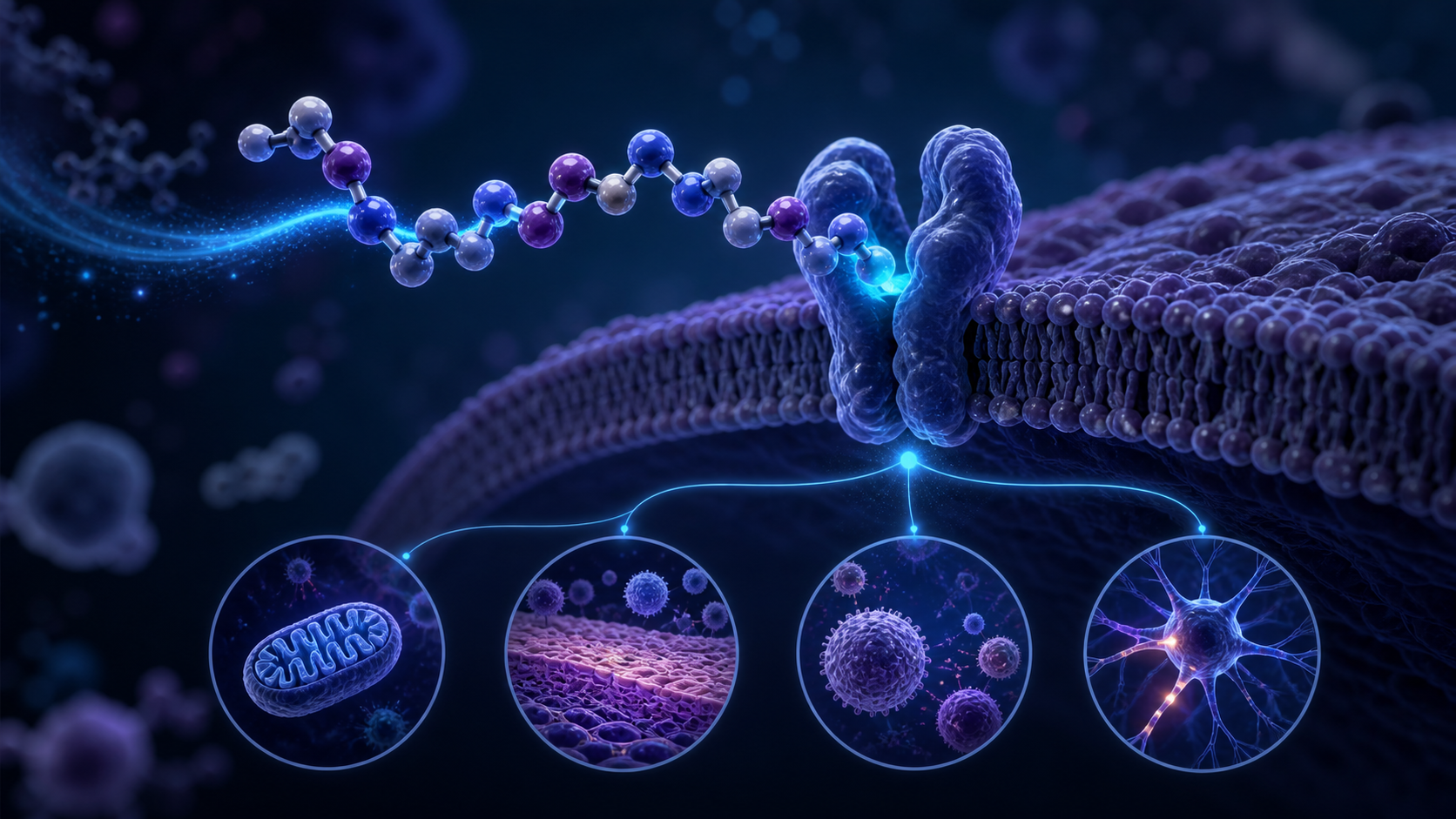
What Are Peptides?
Peptides are short chains of amino acids. Many function as hormones, neurotransmitters, growth factors, antimicrobial molecules, or other biological messengers. Some peptide-based medicines are backed by large clinical programs and regulatory approval. Others remain laboratory tools, early drug candidates, compounded preparations, or products sold only for research.
That range is why “peptides” should not be treated as one category with one safety profile or one set of expected benefits. Insulin, a GLP-1 receptor agonist, a topical copper peptide, and an investigational repair peptide differ in structure, target, route, evidence, manufacturing requirements, and risk. A useful research process begins by defining the question, identifying the exact molecule, and separating what is known in humans from what is only suggested by cells, animals, or anecdotes.
How Peptide Structure Shapes Function
Amino acids connect through peptide bonds. A relatively short chain is generally called a peptide; longer, folded chains are usually described as proteins, though the boundary is not absolute. The order of amino acids determines the molecule’s shape, charge, stability, and ability to interact with a biological target.
The body produces thousands of signaling peptides. Researchers can also synthesize natural sequences, shorten them to active fragments, attach stabilizing groups, substitute amino acids, or create analogues designed to last longer or bind more selectively. Small structural changes can alter half-life, potency, receptor activity, immune recognition, and manufacturing complexity. Similar names therefore do not guarantee interchangeable molecules.
How Peptides Work in the Body
Many peptides bind to receptors on the surface of a cell. That interaction changes activity inside the cell through a signaling pathway. Other peptides cross membranes, interact with enzymes, bind metals, disrupt microbes, or participate in structural and regulatory processes.
The popular “key and lock” analogy is helpful but incomplete. Receptors may be more or less abundant in different tissues, multiple pathways can converge on the same outcome, and the same pathway can behave differently depending on dose and context. A laboratory finding that a peptide activates a receptor does not tell us how much reaches that receptor in a person, how long the signal lasts, or whether the downstream effect is beneficial.
Approved Peptides vs Compounded and Research Peptides
More than 80 peptide drugs have reached the market across areas including diabetes, cancer, osteoporosis, multiple sclerosis, HIV, and chronic pain. Approval means a specific drug product, formulation, indication, manufacturing process, and labeling have been evaluated through a regulatory pathway. It does not mean every peptide—or every version of the same active sequence—is approved.
A compounded drug is prepared for a patient under specific legal conditions and is not FDA-approved. FDA does not verify compounded drugs for safety, effectiveness, and quality before marketing in the same way it evaluates approved products. A research-use-only product occupies a different category again: it is not labeled as a medicine for human use. Third-party testing may provide valuable analytical information, but it does not transform a research chemical into an approved drug.
Always check the status of the exact molecule, route, and product. Discussions online often blend evidence from an approved drug with an investigational analogue, or borrow animal findings for a retail preparation that has never been studied clinically.
How to Evaluate Peptide Research
Explains targets and biological plausibility under controlled conditions. It cannot establish real-world effectiveness or whole-body safety.
Show how a living system responds and help select doses and endpoints. Species differences can prevent direct translation to people.
May evaluate exposure, tolerability, dosing, and preliminary signals. Small or uncontrolled studies cannot settle efficacy questions.
Provide stronger estimates of benefit and harm when adequately powered, well controlled, transparently reported, and replicated.
Anecdotes can identify questions worth studying, but they cannot separate treatment effects from natural recovery, expectation, concurrent interventions, selective reporting, or regression toward the mean. The right conclusion should match the strongest available level of evidence—not the most enthusiastic story.
How to Choose a Peptide Research Goal
Beginning with “Which peptide should I use?” encourages a product-first search. A better approach is to define the outcome, current baseline, timeframe, and evidence standard. Are you researching metabolic control, soft-tissue recovery, immune signaling, sleep, skin biology, or mitochondrial function? Is the goal a symptom, a laboratory value, a performance metric, or understanding a mechanism?
Once the question is specific, irrelevant compounds fall away. You can compare candidates by target, evidence, route, duration, safety concerns, monitoring requirements, and whether an approved option already exists. Clear success and stop criteria also make a protocol interpretable rather than an open-ended experiment where every change is credited to the newest addition.
How to Read a Peptide Dosing Protocol
A useful protocol explains the exact compound and form, route, timing, duration, rationale, monitoring, contraindications, interaction concerns, storage, and criteria for reassessment. Dose information without those elements is incomplete and may be misleading when copied between products or populations.
Route matters because oral, topical, nasal, and injected preparations can produce very different exposure. Half-life matters because it changes dosing frequency and accumulation. Formulation matters because salts, preservatives, buffers, and delivery systems can affect stability and absorption. Patient-specific factors—including diagnoses, pregnancy, medications, allergy history, kidney or liver function, cancer history, and baseline laboratory results—can change the risk calculation entirely.
How to Evaluate a Peptide COA
For any peptide product, identity comes first: is the principal material the molecule named on the label? HPLC area purity alone cannot answer that question. A stronger analytical package combines identity testing with quantitative content and an impurity profile. Products intended to be sterile require separate sterility and bacterial-endotoxin testing.
The limitations of HPLC area purity become especially important when evaluating handling claims. Our analysis of whether shaking damages reconstituted peptides examines a retatrutide comparison in which the shaken vial retained high HPLC area purity, while aggregation, particles, and biological potency remained unmeasured.
Batch relevance matters. A report from another lot, an old manufacturing run, or a generic example does not establish the quality of the vial being evaluated. Laboratory attribution, report verification, sampling, chain of custody, test dates, methods, acceptance criteria, and unedited result pages all affect how much confidence a certificate of analysis deserves.
Peptide Protocols keeps these questions separate. Our guide to how COA Grades evaluate a vendor’s testing trail explains the evidence standard. Verified vendor reviews address fulfillment and customer experience, while the Peptide Price Index compares available vial sizes, stock, and pricing. None of those measures is a substitute for the others.
Peptide Safety and Evidence Gaps
When human data are sparse, the absence of a documented problem does not prove safety. Potential risks can arise from the peptide’s pharmacology, excessive or prolonged signaling, immune reactions, interactions, degradation products, impurities, contamination, inaccurate content, or a route that was never studied.
FDA has identified limited safety information and quality concerns for several peptides promoted in wellness markets, including possible immunogenicity from aggregates or peptide-related impurities. Those concerns vary by compound and route; they should not be generalized into “all peptides are dangerous” or dismissed as irrelevant.
A licensed clinician can evaluate whether an approved or legally compounded option is appropriate, identify contraindications, interpret baseline data, and establish monitoring. Urgent symptoms or serious adverse reactions require medical care—not troubleshooting through an online protocol.
A Step-by-Step Peptide Research Checklist
- Define the question. Name the outcome, baseline, timeframe, and what would count as meaningful evidence.
- Confirm the exact identity. Distinguish the peptide, analogue, salt, fragment, blend, and route.
- Check regulatory status. Separate approved products from compounded drugs and research chemicals.
- Map the evidence. Keep cell, animal, early human, and controlled clinical findings in separate columns.
- Read the complete protocol. Include monitoring, limitations, interactions, storage, and stop criteria—not dose alone.
- Evaluate product evidence. Review identity, quantity, purity, sterility, endotoxins, lot matching, and laboratory verification.
- Compare vendors by distinct measures. Testing, customer experience, stock, and price answer different questions.
- Document and reassess. A research journal prevents memory and expectation from rewriting the result.
Frequently Asked Questions About Peptides
Are all peptides approved medications?
No. Peptides are a diverse molecular class that includes established medicines, investigational drug candidates, laboratory tools, compounded preparations, and poorly characterized products promoted ahead of their evidence.
Does a clinical-trial dose become a treatment recommendation?
No. A trial dose describes what researchers studied in a defined population and protocol. It does not automatically establish an appropriate dose, route, duration, or monitoring plan for an individual.
Does high HPLC purity prove peptide identity or sterility?
No. HPLC area purity describes a chromatographic result. Identity, quantitative content, sterility, bacterial endotoxin, particles, and biological potency require separate evidence.
The most reliable starting point is to identify the molecule, define the question, match the conclusion to the evidence, and keep product quality separate from biological plausibility.
Sources and Further Reading
- Muttenthaler M, et al. Trends in peptide drug discovery. Nature Reviews Drug Discovery. 2021.
- Wang L, et al. Therapeutic peptides: current applications and future directions. Signal Transduction and Targeted Therapy. 2022.
- U.S. Food and Drug Administration. Clinical Pharmacology Considerations for Peptide Drug Products. 2023.
- U.S. Food and Drug Administration. Compounding and the FDA: Questions and Answers.
- U.S. Food and Drug Administration. Guidance for Industry: ANDAs for Certain Highly Purified Synthetic Peptide Drug Products. 2021.
Put the framework to work
Browse the Peptide Library for compound-specific mechanisms, evidence, protocols, safety considerations, and vendor pricing.
Explore the Peptide Library