What Does the Semax Evidence Show?
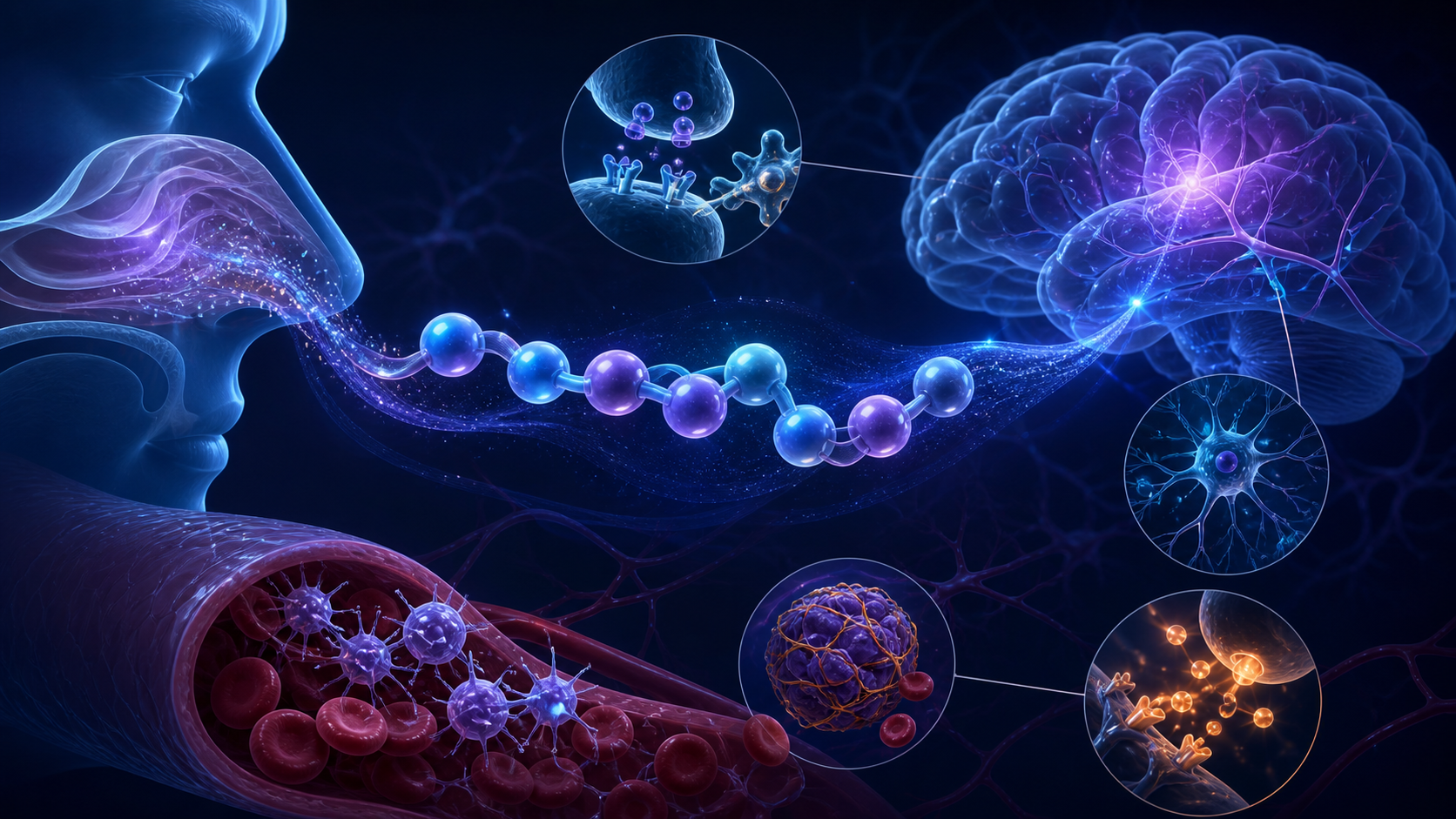
Semax is Met-Glu-His-Phe-Pro-Gly-Pro, a synthetic ACTH(4–10) analog stabilized with a C-terminal Pro-Gly-Pro sequence. It is registered as a nasal drug in Russia for ischemic-stroke recovery. That is unusual among research peptides: Semax has a national-label history, not only a vendor narrative.
For a broader overview of the compound, see our Semax reference guide. This article focuses on the neuroprotection evidence and the unresolved bleeding and stimulant-interaction questions.
The strongest published signals remain preclinical. Rat studies report rapid hippocampal BDNF and TrkB upregulation, smaller infarcts and altered inflammatory-gene expression after experimental ischemia, and protection of memory performance under oxygen stress.
Human reports are directionally consistent with faster post-stroke recovery and selected EEG or default-mode-network changes. Most are open-label, conventional-care-controlled, Russian-language studies below the design standard expected for a modern drug application.
FDA staff also emphasized rodent findings that marketing summaries often omit: anticoagulant, antithrombotic and fibrinolytic activity, including reduced platelet aggregation, plus potentiation of amphetamine-induced striatal dopamine release and locomotion in mice. PCAC recommended 503A listing by an 8–5 vote with one abstention, but that advisory vote was not approval and did not resolve the interaction evidence.
What Is Semax?
Semax retains the ACTH(4–7) tetrapeptide Met-Glu-His-Phe and adds Pro-Gly-Pro to slow peptidase degradation. It does not carry the full steroidogenic activity of ACTH. The established clinical route in Russia is intranasal; U.S. research and compounding nominations also contemplated subcutaneous use.
Uses proposed before PCAC were cerebral ischemia, migraine and trigeminal neuralgia. Wellness marketing extends those claims to attention, working memory and broad “neuroprotection.” These are separate evidence packages and should not be treated as interchangeable.
The receptor-level mechanism has not resolved to one clean target. Reports describe melanocortin-receptor interactions, saturable forebrain-membrane binding and downstream transcriptional effects. Neurotrophin signaling is the most replicated functional readout, not a conventional stimulant-binding profile.
Semax should also not be confused with semaxanib, an unrelated VEGFR inhibitor. FDA's acting committee chair identified that naming collision as a health-literacy concern.
What the Semax BDNF and TrkB Studies Found
The most-cited mechanistic paper is Dolotov and colleagues' 2006 Brain Research study. After a single 50 µg/kg Semax exposure in rats, the investigators reported approximately a 1.4-fold rise in hippocampal BDNF protein, a 1.6-fold rise in TrkB tyrosine phosphorylation, a three-fold rise in exon-III BDNF mRNA and a two-fold rise in TrkB mRNA. Conditioned-avoidance responses also increased in the same animals.
This creates a molecular-to-behavior link in rodents. It does not provide a human effect size, establish a cognitive-enhancement dose for healthy people or show that greater BDNF signaling is always beneficial.
Later focal-ischemia studies expanded the mechanism to immune, vascular and neurotransmitter gene networks. In a transient middle-cerebral-artery-occlusion model, Sudarkina and colleagues reported more active CREB in subcortical tissue, less MMP-9 and c-Fos in adjacent cortex, and less active JNK across affected regions 24 hours after treatment. That profile is consistent with reduced inflammatory or cell-death signaling and greater recovery-pathway activity in rats after experimental stroke.
Semax Cognitive and Neuroprotection Signals in Animals
Published rodent studies report improved acquisition in food-motivated and passive-avoidance tasks, protection against stress- or scopolamine-related impairment, and better Morris-water-maze performance after experimental ischemia.
Multiple middle-cerebral-artery-occlusion studies report smaller infarcts and better neurological scores than vehicle. Effect sizes summarized as roughly 25% to 40% infarct-volume reductions are model- and protocol-dependent and cannot be translated directly into a human stroke benefit.
A recent APPswe/PS1dE9 mouse study reported that Semax and a related heptapeptide improved behavioral outcomes and reduced amyloid inclusions, with some effects persisting after dosing. This is disease-model work, not a human Alzheimer's disease trial.
An Air Force Research Laboratory report provides an uncommon independent Western preclinical signal. Four weeks of daily intranasal Semax protected Sprague-Dawley rats against memory-performance losses during repeated hypoxia, hyperoxia and oscillating hypoxia–hyperoxia. The broader pattern is that Semax effects are easier to detect in perturbed brains than as baseline cognitive amplification in unchallenged animals.
What Human Semax Studies Can and Cannot Establish
Semax has human publications, but it lacks modern, independently replicated, placebo-controlled Western trials for the claims currently used to market it.
Russian acute-stroke studies from the late 1990s compared Semax plus intensive therapy with conventional care and reported faster regression of focal deficits, particularly motor symptoms. A 2018 rehabilitation study of 110 patients used 6,000 µg/day intranasal Semax in two 10-day courses and reported higher plasma BDNF plus improved Barthel and motor scores compared with patients not receiving Semax.
Allocation was often nonrandomized or incompletely described, blinding was weak or absent, and controls generally received usual care rather than placebo. Publication is concentrated in Russian-language journals, and English abstracts frequently omit statistical detail. FDA staff stated that several submitted references lacked sufficient English-language information for full evaluation. For migraine and trigeminal neuralgia, staff characterized the relevant human evidence as two small uncontrolled studies that did not resolve effectiveness.
Older healthy-volunteer reports described EEG changes after Semax. A small placebo-controlled resting-state fMRI study in 24 healthy middle-aged adults reported increased default-mode-network volume in medial frontal cortex after 1% intranasal Semax. This was an imaging signal, not a clinical cognitive-outcome trial. No adequate human pharmacokinetic package exists for the nominated subcutaneous route, and no dedicated abuse-potential study was identified.
Does Semax Have Anticoagulant or Antiplatelet Activity?
The anticoagulant concern comes from a documented rodent pharmacology literature that FDA included in its briefing. Studies of Semax and related proline-rich glyprolines reported increased plasma anticoagulant and fibrinolytic activity after intranasal administration.
Under acute or chronic immobilization stress, Semax produced a hypocoagulable pattern in rats: longer partial-thromboplastin time, greater fibrinolytic or tissue-plasminogen-activator activity, and reduced platelet aggregation. A Russian patent also claimed antithrombotic, anticoagulant, fibrin-depolymerizing and fibrinolytic activity in experimental rat models.
Secondary summaries of the FDA record place one platelet-aggregation reduction near 35% after approximately 1 mg/kg intranasal Semax in rats. Staff noted the lack of dose-response evidence needed to determine whether a potentially useful antithrombotic effect could be separated from an effect that favors bleeding.
These are animal findings, not human bleeding-outcome data. There is no established rate of Semax-related major bleeding and no clinical interaction study with warfarin, direct oral anticoagulants, dual antiplatelet therapy or serotonergic antidepressants. The absence of quantified human risk is not evidence that these combinations are safe.
What the Semax and Amphetamine Study Showed
A 2005 mouse study reported that Semax potentiated amphetamine-induced dopamine release in the striatum and amphetamine-induced locomotor activity. Other rodent work suggests serotonergic modulation, but Semax is not a selective serotonin-reuptake inhibitor.
FDA staff interpreted increased striatal dopaminergic tone of this type as a response associated with drugs of abuse. Staff also said the nominator had not submitted, and FDA had not identified, nonclinical toxicity studies adequate to evaluate abuse potential, particularly for the nominated subcutaneous route.
This does not prove that Semax is addictive, equivalent to prescription amphetamine, or clinically dangerous when combined with a stimulant. It does establish a mechanistic interaction flag for combinations with amphetamines, other dopaminergic stimulants or high-dopamine research stacks. Human abuse potential and drug-interaction magnitude remain uncharacterized.
What FDA Staff and PCAC Concluded About Semax
FDA reviewed Semax free base and acetate for nominated uses including cerebral ischemia, migraine and trigeminal neuralgia. Staff described a literature base that was often Russian-language and incomplete about route, dose or methods; weak human evidence for the pain indications; no human pharmacokinetic data for injectable use; rodent anticoagulant and antithrombotic activity; and amphetamine-dopamine potentiation that raised an unresolved abuse-liability and stimulant-interaction question.
Staff recommended against adding Semax free base or acetate to the 503A Bulks List. On July 24, 2026, PCAC voted eight yes, five no and one abstention to recommend listing. The majority discussion emphasized access and the possibility of moving existing use into licensed pharmacies.
The vote was advisory. It did not approve Semax, establish safety or efficacy, authorize compounding by itself, or close the bleeding and interaction evidence gaps. Formal rulemaking is still required before a substance is added to the list.
Which Semax Claims Are Supported?
Supported in rodents: A single Semax exposure can increase hippocampal BDNF and TrkB signaling; multiple experimental-ischemia studies report favorable injury and recovery markers; an independent oxygen-stress study reported cognitive protection.
Directionally consistent but design-limited: Russian stroke series report faster recovery than conventional-care comparisons.
Not established: Modern clinical efficacy for cognition, migraine or stroke; quantified human bleeding risk; safe combination with anticoagulants, antiplatelets, serotonergic antidepressants or stimulants; and human abuse potential.
Supported as a mechanistic flag: Semax has anticoagulant, fibrinolytic and antiplatelet activity in rat studies and potentiates amphetamine-evoked striatal dopamine release in mice.
Research Verdict: What the Semax Evidence Really Shows
Semax has a denser mechanistic and clinical record than most gray-market peptides. BDNF and TrkB findings, ischemia transcriptomics and middle-cerebral-artery-occlusion outcomes are internally consistent. An independent U.S. military rodent study adds support for cognitive protection during physiological stress. Russian stroke use is documented history, not an internet invention.
Efficacy for the claims that drive U.S. interest—everyday focus, migraine, trigeminal neuralgia and broad neuroprotection in healthy people—has not been established to a modern clinical-trial standard.
The same molecule that appears neuroprotective in an ischemic rat also produces hypocoagulable and amphetamine-sensitizing signals in other rodent experiments. Those findings are sparse, old and not dose-mapped to human nasal exposure. They nevertheless represent the specific unresolved findings FDA staff cited when recommending against listing.
The defensible conclusion is narrow: Semax is an ACTH-fragment analog with replicated neurotrophin and ischemia-model activity, a Russian stroke-use history supported by modest-quality clinical reports, an unquantified anticoagulant signal, and an unstudied stimulant-interaction and abuse-liability question. Combining it with blood thinners, antiplatelet drugs, serotonergic antidepressants or amphetamines is an untested hypothesis, not a characterized protocol.
Sources: Semax Neuroprotection, Hemostasis and Regulatory Review
- Dolotov OV, et al. Semax, an analog of ACTH(4-10) with cognitive effects, regulates BDNF and trkB expression in the rat hippocampus. Brain Research. 2006;1117:54–60.
- Medvedeva EV, et al. The peptide semax affects the expression of genes related to the immune and vascular systems in rat brain focal ischemia: genome-wide transcriptional analysis. BMC Genomics. 2014;15:228.
- Filippenkov IB, et al. Novel Insights into the Protective Properties of ACTH(4-7)PGP (Semax) Peptide at the Transcriptome Level Following Cerebral Ischaemia–Reperfusion in Rats. Genes. 2020;11:681.
- Sudarkina OY, et al. Brain Protein Expression Profile Confirms the Protective Effect of the ACTH(4–7)PGP Peptide (Semax) in a Rat Model of Cerebral Ischemia–Reperfusion. International Journal of Molecular Sciences. 2021;22:6179.
- Eremin KO, et al. Semax, an ACTH(4-10) analogue with nootropic properties, activates dopaminergic and serotoninergic brain systems in rodents. Neurochemical Research. 2005.
- Cherkasova KA, et al. Comparative study of modulatory effects of Semax and primary proline-containing peptides on hemostatic reactions. 2001. Grigorjeva ME, Lyapina LA. Anticoagulation and antiplatelet effects of semax under conditions of acute and chronic immobilization stress. 2010.
- Lyapina LA, et al. Comparison of anticoagulant effects of regulatory proline-containing oligopeptides: specificity of glyprolines, semax, and selank. Izvestiia Akademii Nauk. Seriia Biologicheskaia. 2006.
- Gusev EI, et al. Effectiveness of semax in acute period of hemispheric ischemic stroke. 1997. The efficacy of semax in the treatment of patients at different stages of ischemic stroke. 2018. Zhurnal Nevrologii i Psikhiatrii imeni S.S. Korsakova.
- Lebedeva IS, et al. Effects of Semax on the Default Mode Network of the Brain. Bulletin of Experimental Biology and Medicine. 2018;165:653–656.
- Ellis D, et al. Protection of Episodic Memory by Neuroprotective Peptide Treatments in Sprague-Dawley Rats Subjected to Hypoxic Exposure. American Journal of Biomedical Science & Research. 2020;10:196–209.
- Food and Drug Administration. Pharmacy Compounding Advisory Committee briefing document for Semax-related bulk drug substances. 2026. Official July 23–24, 2026 meeting materials.
More Peptide Mechanism and Safety Research
Explore evidence-first reviews of emerging peptide mechanisms, laboratory findings, regulatory records, and unresolved safety questions.
Browse All Articles