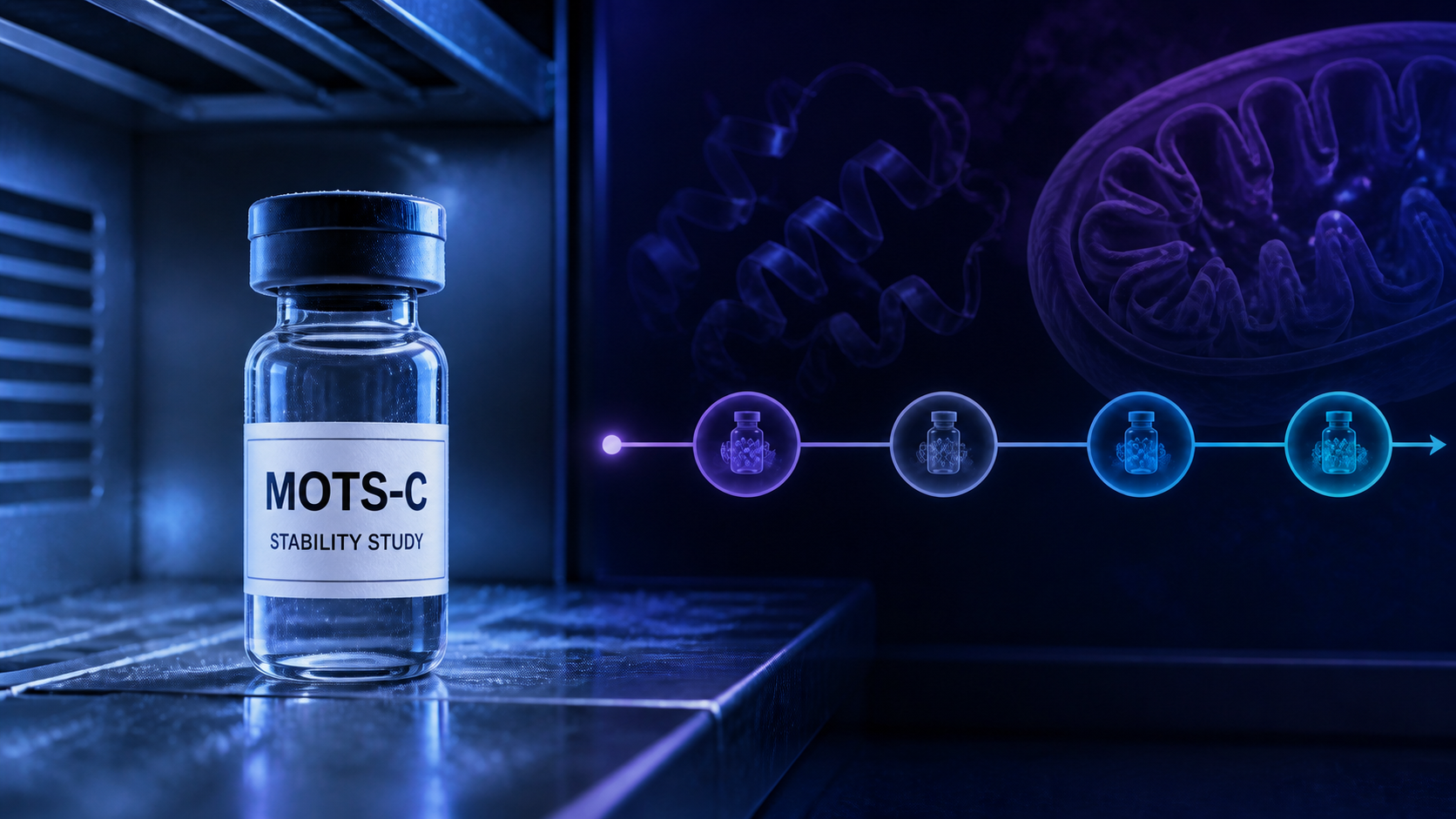
MOTS-c Stability After Reconstitution: The Short Answer
A vendor-published stability series followed one reconstituted MOTS-C lot under refrigeration for 30 days. Reported chromatographic purity was 99.279% at baseline, 99.316% on day 7, 99.125% on day 14, and 97.940% on day 30. That is a small net decline in relative purity through the first two weeks and a larger—but still limited—drop by the final measurement.
The reported volume measurement moved more noticeably: from 11.45 µL/mg at baseline to 10.63 µL/mg at day 30, a 7.14% decline. The study therefore supports a narrow conclusion: under its stated conditions, the dominant chromatographic MOTS-C peak remained high for 30 days while measurable sample recovery changed over time. It does not, by itself, establish potency, sterility, clinical safety, or a universal storage window.
How the 30-Day MOTS-c Stability Test Was Designed
The report identifies lot PC-Z2-MOT10 and four timepoints: freshly reconstituted baseline, 7 days, 14 days, and 30 days. Each sample was described as reconstituted after receipt and stored in a refrigerator maintained between 35 and 38°F (1.6–3.3°C). The published table tracks average volume per milligram and average purity.
That outline is useful, but several details needed for full reproducibility are not visible in the public summary: the exact diluent and concentration, replicate count, container and closure, pH, light exposure, sampling procedure, temperature logs, chromatographic method, identity confirmation, quantitative assay, and acceptance criteria. Without those details, the results should be treated as a documented observational series—not a validated stability program.
MOTS-c HPLC Purity at 7, 14 and 30 Days
The reported change at day 7 was effectively flat: average purity moved from 99.279% to 99.316%, a relative increase of 0.04%. A tiny increase does not mean the sample became purer. It is more reasonably interpreted as normal analytical or sampling variation unless method precision shows otherwise.
By day 14, average purity was 99.125%, only 0.15% below baseline. At day 30, purity was 97.940%, a 1.35% reduction from the starting result. That final shift is directionally consistent with accumulating chemical change, but the public summary does not show chromatograms, impurity identities, method variability, or replicate-level data. Those omissions limit how confidently the size and mechanism of degradation can be interpreted.
Why the Recovered Vial Volume Changed
Average volume was reported as 11.45 µL/mg at baseline, 11.41 at day 7, 10.96 at day 14, and 10.63 at day 30. The corresponding changes were −0.35%, −4.24%, and −7.14%. A falling recovered volume could reflect evaporation, sampling losses, adsorption, measurement variation, or another handling effect. The public report does not provide enough method detail to distinguish among them.
This matters because chromatographic area percent is relative. A remaining sample can still show a high percentage for its main peak even if the total amount of recoverable material has changed. A stronger design would pair relative purity with a validated quantitative content assay, mass balance, and clearly documented sampling volumes.
What HPLC Cannot Establish About MOTS-c Stability
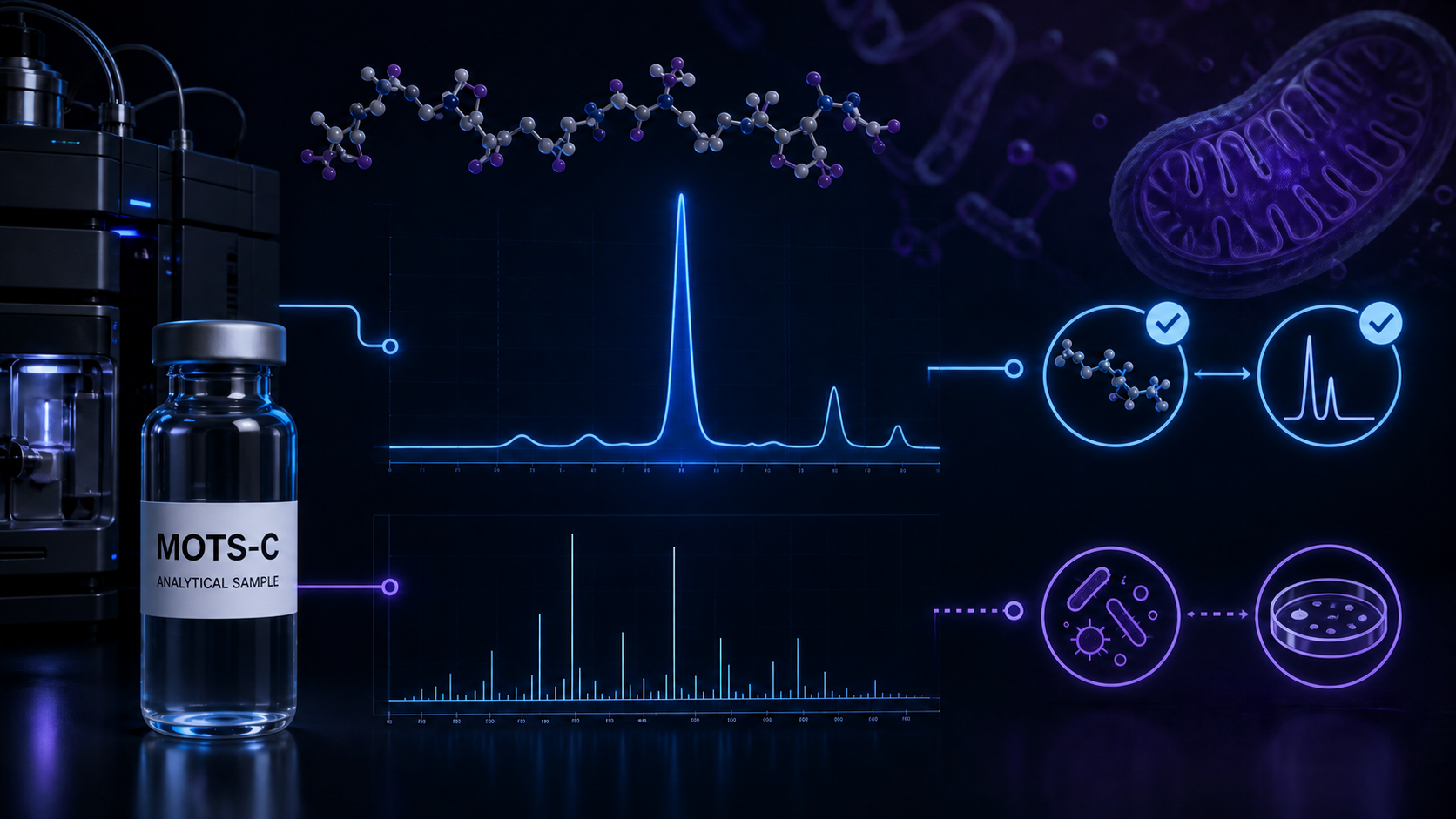
MOTS-C is a 16-amino-acid mitochondrial-derived peptide first described as a regulator of metabolic homeostasis. Its sequence contains two methionine residues and one tryptophan, residues that can be vulnerable to oxidative change in aqueous environments. A conventional purity percentage may show new chromatographic peaks, but it does not automatically identify what those peaks contain.
High-resolution mass spectrometry can help distinguish intact MOTS-C from oxidized species and other mass-shifted products. That distinction is important: a vial reported as 98% main peak with 2% oxidized material is analytically different from one with 2% truncated sequences or unrelated synthesis impurities. Our guide to reading a peptide COA explains why identity, purity, and quantity answer separate questions.
Chemical Stability vs Sterility and Potency
The measured purity trend addresses one chemical quality attribute. It does not demonstrate that the peptide retained the same biological activity at every timepoint. A fit-for-purpose bioassay would be needed to connect structural preservation with functional potency.
The report also does not include sterility, endotoxin, particulate, or container-closure testing. A solution can retain a strong chromatographic peak while becoming microbiologically unsuitable. Refrigeration can slow microbial growth, but it does not make a repeatedly accessed vial sterile or convert analytical purity data into an administration guideline.
That is why the result should not be translated into a consumer instruction such as “MOTS-C is good for 30 days.” It supports a much narrower statement about chemical purity and recovered volume in one lot under one reported refrigerated condition.
How Long Does Reconstituted MOTS-c Last?
A 2026 evidence review from the Alzheimer's Drug Discovery Foundation summarizes high-resolution mass-spectrometry work in which exogenous MOTS-C reconstituted in water reportedly showed no significant methionine oxidation for at least 30 days at 4°C. That account is directionally consistent with the vendor series showing a largely preserved principal peak under refrigeration.
However, the same review also discusses conflicting findings for endogenous MOTS-C in biological samples, where measured levels can fall quickly depending on assay type and handling. These are not equivalent experiments. Stability in a controlled vial, stability in plasma, and biological half-life in a living system answer different questions and should not be combined into a single number.
What Stronger MOTS-c Stability Evidence Would Require
- Multiple independent lots, replicate vials, and a clearly stated reconstitution formulation.
- Documented concentration, pH, vial material, closure system, light exposure, and temperature history.
- Baseline and scheduled timepoints with full chromatograms and method precision.
- LC-MS identity and targeted monitoring for methionine oxidation and other degradants.
- A quantitative content assay to separate relative purity from actual peptide recovery.
- Aggregation and particle testing appropriate to the formulation.
- A biological potency assay when the conclusion extends to retained function.
- Separate sterility and endotoxin testing for any microbiological claim.
- Predefined acceptance criteria and independent laboratory verification.
Research Verdict: What the 30-Day Data Supports
The published series is more informative than repeating an unsupported rule that every reconstituted peptide rapidly becomes unusable. It provides named timepoints, a stated refrigerated range, a lot number, and numerical trends for both purity and volume. Those are meaningful improvements over anecdote.
The most defensible conclusion is that this MOTS-C lot retained a high relative chromatographic purity through 30 days under the reported refrigerated conditions, while sample volume declined and the principal purity result moved downward by the final timepoint. Researchers should avoid extending that observation to sterility, potency, safety, or other formulations. For broader handling principles, see the Peptide Protocols peptide storage guide; for another example of evidence boundaries, compare our analysis of 90-day BPC-157 stability testing.
Sources: MOTS-c Stability Research
- Peptide Crafters. Stability Study of MOTS-c Peptide Following Reconstitution and Refrigerated Storage. Vendor-published analytical report. Accessed 2026.
- Lee C, et al. The mitochondrial-derived peptide MOTS-c promotes metabolic homeostasis and reduces obesity and insulin resistance. Cell Metabolism. 2015.
- Reynolds JC, et al. MOTS-c is an exercise-induced mitochondrial-encoded regulator of age-dependent physical decline and muscle homeostasis. Nature Communications. 2021.
- Alzheimer's Drug Discovery Foundation. MOTS-c evidence review. Cognitive Vitality. 2026.
- European Medicines Agency. Guideline on the development and manufacture of synthetic peptides. 2026.
Keep storage claims tied to the test
Explore more evidence-first peptide research, analytical breakdowns, and practical protocols.
Browse All Articles