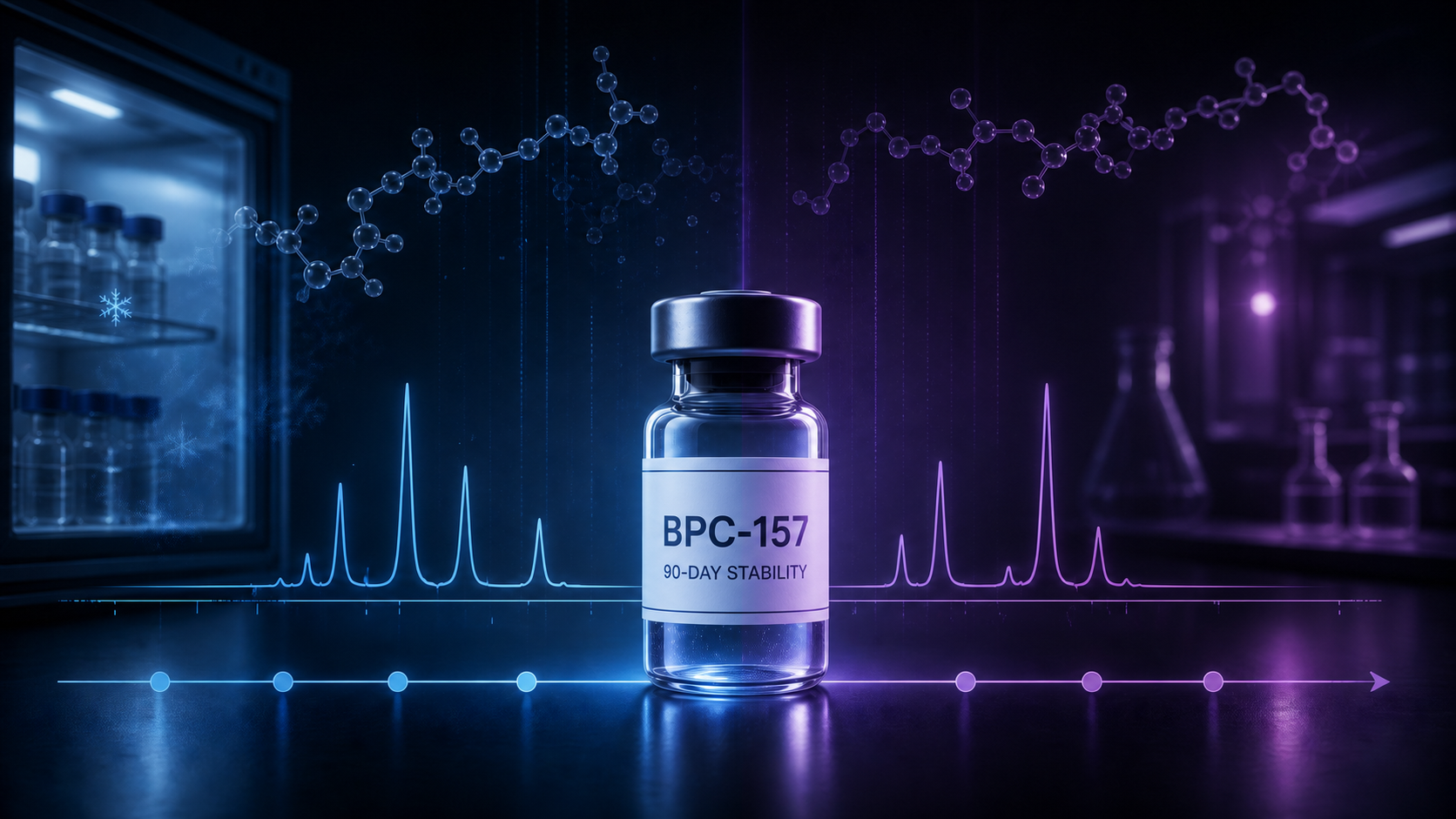
BPC-157 Stability After Reconstitution: The Short Answer
Long-term testing of reconstituted BPC-157 can help show whether the main peptide peak remains detectable and whether new chromatographic impurities appear under defined storage conditions. A side-by-side refrigerated and room-temperature comparison is especially useful for estimating how strongly heat accelerates chemical change.
But a result such as “high purity after 90 days” is not the same as proving full potency, sterility, freedom from aggregates, or suitability for human use. Those claims require different measurements. The study must also identify the exact sample, diluent, concentration, container, storage temperatures, timepoints, analytical methods, and acceptance criteria before its conclusion can be evaluated.
How the 90-Day BPC-157 Stability Test Was Designed
Once a lyophilized peptide is dissolved, water enables degradation pathways that are far less active in the dry state. A longitudinal study asks how quickly the reconstituted material changes and whether cold storage slows that change relative to an ambient control.
The strongest design begins with equivalent samples from the same lot, prepared at the same concentration with the same diluent and container. One group is held at a documented refrigerated range—commonly 2–8°C—while another remains at a monitored room temperature. Baseline testing is essential because every later result must be compared with the material at day zero, not merely with a specification printed on a vendor page.
Which BPC-157 Formulation Was Tested?
BPC-157 is sold under inconsistent naming conventions, including free-base and acetate forms. FDA reviewers have noted that commercially available materials may use different salts or derivatives under the same common name. A useful report therefore needs identity confirmation and a clear statement of the tested form.
The diluent matters too. Bacteriostatic water, sterile water, saline, and buffered solutions do not create interchangeable formulations. Concentration, pH, preservatives, excipients, vial materials, headspace, and closure integrity can affect chemical degradation, adsorption, aggregation, and microbial risk. A 90-day result belongs to the tested formulation and container—not automatically to every vial labeled BPC-157.
What the HPLC Results Showed
Reversed-phase HPLC can separate the main peptide peak from many chemical impurities. Tracking peak area and retention time across baseline and later timepoints can reveal new degradants or a declining principal peak. Mass spectrometry can strengthen the analysis by checking whether the principal peak still has the expected molecular mass.
Area percent is a relative measurement. A sample can retain a high percentage for its main chromatographic peak even if total recovered peptide has fallen through precipitation, adsorption to the vial, or losses during sample preparation. For that reason, a convincing stability report should pair relative purity with a quantitative assay or recovery measurement and show the actual chromatograms—not just a pass/fail statement.
HPLC also does not capture every possible aggregate. FDA’s BPC-157 review specifically notes that multiple analytical methods may be needed to detect peptide aggregation, including size-based techniques. Visual clarity is not a substitute: a solution may look unchanged while chemical degradation or subvisible particles are present.
How Temperature Affected BPC-157 Stability
A refrigerated-versus-ambient comparison should include several timepoints. Testing only at baseline and day 90 can miss when degradation began, whether it accelerated, and whether the samples followed a consistent trend. A sequence such as days 0, 7, 14, 30, 60, and 90 provides a much more useful degradation curve.
If a room-temperature sample changes rapidly while the refrigerated sample remains comparatively stable, the experiment supports cold storage for that formulation. It still does not establish a universal shelf life. Formal stability programs use validated, stability-indicating methods, controlled conditions, predefined specifications, representative batches, and enough sampling to justify an expiration or retest period.
BPC-157 Chemical Stability vs Sterility
A peptide can remain chemically identifiable while the vial becomes microbiologically unacceptable. HPLC and mass spectrometry do not test sterility, bacterial endotoxins, or the integrity of repeated vial entries. A preservative may reduce microbial growth, but it does not turn chemical purity data into a sterility result.
This distinction is especially important when a study lasts 90 days. The label for a bacteriostatic-water product governs that diluent in its approved context; it does not validate an unapproved BPC-157 mixture or prove that a repeatedly punctured research vial remains sterile. Microbial testing, endotoxin testing, container-closure controls, and an aseptic-use study answer different questions from chromatographic purity.
What HPLC Purity Cannot Establish
- Lot number, chemical form, identity method, initial purity, and quantitative content.
- Diluent, concentration, pH, excipients, container, closure, and sample-preparation procedure.
- Actual temperature ranges, light conditions, orientation, agitation, and documented excursions.
- Baseline plus multiple scheduled timepoints for every storage condition.
- Complete chromatograms, mass spectra when used, raw numerical results, and method details.
- A stability-indicating quantitative assay rather than relative area percent alone.
- Aggregation or particle testing when the conclusion extends beyond chemical purity.
- Separate sterility and endotoxin data if the report makes microbiological claims.
- Predefined acceptance criteria, replicates, controls, and an explanation of missing or excluded samples.
- Independent laboratory attribution and a way to verify the unedited report.
How Long Does Reconstituted BPC-157 Last?
If a well-documented sample preserves identity, quantitative content, and a clean impurity profile through 90 days under refrigeration, that is meaningful evidence for the chemical resilience of that specific formulation. If the ambient sample degrades sooner, the contrast strengthens the conclusion that temperature control matters.
The result should still be described narrowly. It does not validate other lots, suppliers, concentrations, diluents, vial systems, or handling patterns. It does not establish biological activity unless an appropriate potency assay was performed. It does not establish sterility or clinical safety. And because BPC-157 is not an FDA-approved drug, there is no approved finished-product specification against which a retail preparation can be declared equivalent.
Research Verdict: Interpreting the 90-Day Result
Longitudinal stability testing is more informative than relying on generic storage advice or assuming every peptide fails after an arbitrary number of days. A transparent 90-day study can map degradation, compare storage temperatures, and identify where a formulation begins to change.
Its value depends on disciplined reporting. The strongest conclusion is not “BPC-157 lasts 90 days.” It is a precisely bounded statement about a verified sample, formulation, container, storage condition, method, and measured quality attribute. Keeping those boundaries visible turns a marketing-friendly experiment into evidence that researchers can actually evaluate. Our explanation of how Peptide Protocols evaluates COA evidence applies the same distinction between a documented result and a broader product claim.
Sources: BPC-157 Stability Research
- U.S. Food and Drug Administration. Review of BPC-157 free base and BPC-157 acetate for use in compounding. Pharmacy Compounding Advisory Committee materials. 2026.
- International Council for Harmonisation. ICH Q1A(R2): Stability Testing of New Drug Substances and Products. 2003.
- International Council for Harmonisation. ICH Q5C: Stability Testing of Biotechnological/Biological Products.
- Zapadka KL, et al. Factors affecting the physical stability (aggregation) of peptide therapeutics. Interface Focus. 2017.
- DailyMed. Bacteriostatic Water for Injection, USP labeling. Updated 2026.
Keep storage claims tied to the evidence
Use the Peptide Protocols library to compare research claims with the methods, limitations, and primary sources behind them.
Browse All Articles