
Does Hospira Bacteriostatic Water Expire After 28 Days?
Hospira’s current Bacteriostatic Water for Injection label does not print a 28-day in-use period. The familiar 28-day limit comes from the default applied to entered multi-dose containers when a manufacturer has not specified a different period.
A separate 2026 experiment followed benzyl alcohol in three Hospira vials for 120 days. It found that the preservative signal remained near baseline through day 90 and declined by day 120. That does not mean the vials were proven sterile for 90 or 120 days: the experiment measured preservative chemistry, not microbial contamination.
What the Hospira Label Actually Says
The DailyMed label describes Bacteriostatic Water for Injection as a sterile, nonpyrogenic diluent containing benzyl alcohol. It identifies two multi-dose presentations and requires aseptic technique for each entry. It also says reconstituted drugs should be used promptly unless the drug manufacturer provides storage directions.
| Label field | 30 mL plastic vial | 20 mL fill in 30 mL glass vial |
|---|---|---|
| Benzyl alcohol | 0.9% (9 mg/mL) | 1.1% (11 mg/mL) |
| Container | Semi-rigid polyolefin fliptop | Glass fliptop |
| pH | 5.7; range 4.5–7.0 | Same range |
| Storage | 20–25°C | 20–25°C |
| Label status | Prescription, multi-dose | Prescription, multi-dose |
The label does not state a 28-day discard date, beyond-use date or extended in-use period. It also warns that benzyl alcohol is not appropriate for neonates and that bacteriostatic agents do not provide complete protection against bacterial contamination.
Why the Standard Says 28 Days
CDC injection-safety guidance says an opened multi-dose vial should be dated and discarded within 28 days unless the manufacturer specifies another period. FDA guidance likewise uses 28 days as the default beyond-use date for an opened or entered multi-dose container when the label does not establish a different period.
The number also aligns with antimicrobial-effectiveness testing that evaluates a preserved product through day 28. It is a standardized in-use boundary, not evidence that benzyl alcohol disappears at midnight on day 29.
The distinction appears in product-specific instructions too. For example, the tesamorelin product label tells users to discard the supplied bacteriostatic water 28 days after first use. That direction concerns the multi-dose diluent bottle; it does not create a 28-day stability claim for every reconstituted peptide.
What the Hospira BAC Water Study Measured
In May 2026, PTDS and PepRecon published a liquid-chromatography experiment that followed one Hospira vial under each of three conditions: room temperature with monthly withdrawals, room temperature with weekly withdrawals and refrigerated storage with weekly withdrawals.
The reported readings stayed near their starting values through day 90. At day 120, all three were lower. The authors estimated method variance at up to 8%, so small point-to-point changes should not be overinterpreted.

The source needs a unit clarification. Its data table labels the values as mg/mL, while its infographic and discussion interpret the same numbers as percent by volume. Those descriptions cannot both be correct for a product labeled 9 mg/mL. Our chart therefore reproduces the numeric series as reported without assigning a unit.
The useful conclusion is narrow: in these three vials, the reported benzyl-alcohol signal did not collapse at day 28. The design used one vial per condition, one product lot and no microbial challenge. It cannot establish a new in-use period.
Preservative Concentration Is Not a Sterility Test
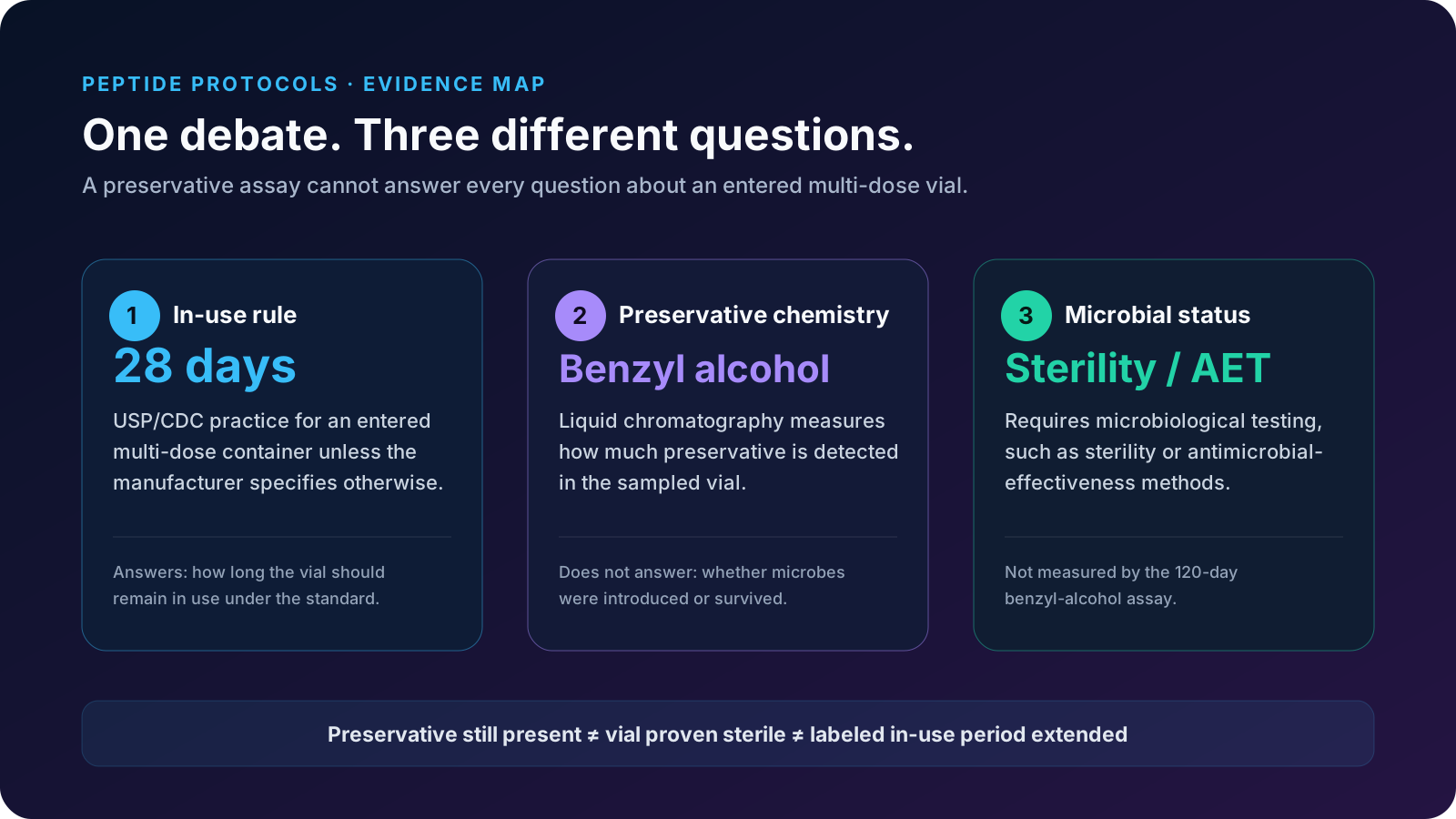
A chromatography assay can estimate how much benzyl alcohol remains. It does not determine whether a stopper was touched, whether an organism entered during a draw, whether particles were introduced or whether microbes survived in a particular vial.
Those questions require microbiological methods. A preservative can reduce microbial growth without guaranteeing that an entered container is sterile. This is why a chemistry result and a beyond-use standard can point in different directions without contradicting one another.
The Water and the Peptide Do Not Share One Stability Clock
Once a peptide is dissolved, the diluent label no longer answers every storage question. Oxidation, hydrolysis, aggregation and adsorption depend on the peptide, formulation, pH, temperature, light and container. The Hospira insert therefore says to use reconstituted solutions promptly unless the dissolved drug’s manufacturer provides storage directions.
The reverse is also true: a peptide-specific storage period does not extend the in-use period of the diluent vial. These are separate products with separate evidence. Our peptide storage guide explains the broader stability variables, while our review of whether shaking damages reconstituted peptides shows why a single analytical method cannot answer every handling question.
What the 2019 Hospira Recall Does—and Does Not—Show
In 2019, Hospira recalled lot W20308 of the 30 mL presentation because a manufacturing investigation found a lack of sterility assurance for some vials. That event matters as a reminder that sterility is a manufacturing and microbiological question.
It does not establish that properly manufactured vials become contaminated on day 29, and it does not validate longer use of other lots. A manufacturing recall and an after-opening beyond-use date address different risks.
What the Evidence Supports
| Claim | Status |
|---|---|
| The 30 mL plastic Hospira vial contains 0.9% benzyl alcohol. | Supported by the label |
| The Hospira label itself prints a 28-day discard instruction. | Not on the current label |
| A 28-day default applies to entered multi-dose vials unless another period is specified. | Supported by CDC and FDA guidance |
| The 2026 experiment found a benzyl-alcohol signal beyond day 28. | Supported for the three tested vials |
| The experiment proved sterility through day 90 or 120. | Not supported |
| A clear vial is documented sterile. | Not supported |
| A reconstituted peptide inherits the remaining time on the water vial. | Not supported |
Research Verdict: Day 28 Is a Use Standard, Not a Chemical Cliff
Hospira does not print a 28-day discard period on the current Bacteriostatic Water for Injection label. The 28-day figure is the standard in-use boundary applied to entered multi-dose containers when a manufacturer has not established another period.
The longer graph adds a useful chemistry observation: the reported benzyl-alcohol signal in three Hospira vials remained measurable well beyond day 28. It does not supply the missing sterility data, overcome the small design or resolve the source’s unit inconsistency.
The evidence-based reading is therefore less dramatic than either internet extreme. Day 28 is not when benzyl alcohol suddenly vanishes. A detectable preservative at day 90 is not proof that a repeatedly punctured vial is sterile or labeled for continued use.
Sources: Hospira Labeling, Multi-Dose Vial Guidance and BAC Water Testing
- DailyMed. Bacteriostatic Water for Injection, USP — Hospira labeling. Updated 2025.
- Centers for Disease Control and Prevention. Preventing Unsafe Injection Practices. Multi-dose vial handling guidance.
- U.S. Food and Drug Administration. Selection of the Appropriate Package Type Terms and Recommendations for Labeling Injectable Medical Products. Multi-dose container guidance.
- United States Pharmacopeia. General Chapter <797>: Pharmaceutical Compounding—Sterile Preparations.
- United States Pharmacopeia. General Chapter <51>: Antimicrobial Effectiveness Testing.
- PTDS / PepRecon. Only 28 Days? Hospira bacteriostatic-water stability assessment. May 2026.
- U.S. Food and Drug Administration. Hospira recall of one lot of Bacteriostatic Water for Injection due to lack of sterility assurance. 2019.
- DailyMed. EGRIFTA WR (tesamorelin) prescribing information. Bacteriostatic-water handling instructions.
More Peptide Stability Research
Explore evidence-first reviews of reconstitution, storage, analytical testing and the limits behind common handling claims.
Browse All Articles